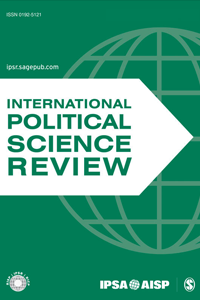
International Political Science Review (IPSR)
47/2
Publication date: Mar 2026
Sage

The March 2026 issue of the International Political Science Review (Volume 47, Number 2) features many current issues dominating world politics.
In Gong Chen examines how and why there is a persistent gender gap in people鈥檚 attitudes towards globalization. Chen argues that countries鈥� levels of modernization are among the strongest predictors of women鈥檚 attitudes toward globalization. Women in modernized, emancipatory cultures tend to identify more with left-of-center, redistributive policies, whereas in countries with more patriarchal societal norms, the gender gap regarding attitudes toward globalization tends to be much smaller.
The article entitled examines the relationship between populist governance, ideology, and sectoral characteristics and how they affect foreign direct investment in Latin America. Drawing on data from 18 Latin American countries, Seungho Lee finds that populism is a key source of institutional unpredictability and can therefore deter FDI.
Reza Hesarzadeh researches the By taking a closer look at the environmental impact of American government sanctions against Iranian companies between 2013 and 2023, Hesarzadeh finds that these punitive measures had significant negative environmental impacts, but that community social capital can offset them in full.
In Ae sil Woo examines term limits in third-wave democracies, arguing that voting rules at the chamber level 鈥� specifically split and joint voting 鈥� can impact presidential efforts to evade term limits, with joint voting facilitating such efforts.
In a study embedded in political psychology, Ahmet Ergurum brings his focus to bear on hawkish leaders and their impact on international relations. His article explores eight cases of leaders from the Middle East and North Africa, finding that 鈥渉awkish鈥� attributes are more complex and by no means homogeneous. Haruka Nagao, Rigao Liu, William Hatungimana, Leeann H. Youn, and John James Kennedy study vaccine diplomacy in Zimbabwe.
Using a survey experiment on vaccine origins and vaccination intentions, the authors鈥� article, entitled finds that country of origin and image affect vaccination intentions and, therefore, vaccine diplomacy as a soft power strategy.
Returning to Iran, the article by Banafsheh Ranji and Kjetil Selvik studies the role that emotions play in legitimizing repression under authoritarian regimes. The Iranian regime used emotional manipulation, the authors argue, as a key tool for fostering unity between its supporters and security forces and backing efforts to violently suppress any opposition.
In Diego Luj谩n and Gonzalo Puig Lombardi study the effect of personalism on the collapse of party systems using the case of El Salvador and the rise of Nayib Bukele. The authors argue that Bukele used self-promotion, ideological dilution, and anti-party rhetoric as strategies for recentering electoral competition in El Salvador鈥檚 two-party system.
In this issue鈥檚 final article, entitled Tom谩s Arias and Patricio Navia examine Chile鈥檚 2021 election scenario, which saw the incumbent candidate lose the first round of elections, while the latter鈥檚 two opponents in the runoff election were also pitted against one another. With economic considerations generally dominated by ideology and sociodemographic factors, the explanatory power of economic factors was much stronger in the runoff election, and these considerations were far less flexible on the right and left of the political spectrum than in the center.
5X社区members can access the dating back to 1980 through the My5X社区menu.